
The Boise Housing Explosion: How Idaho's 31-Year Growth Market Is Creating HVAC Demand
The HVAC Recovery Hub regional audit for Boise, ID confirms Ada County has absorbed 31 consecutive years of net in-migration, compressing aging housing stock into corridors where HVAC failure rates run at historic highs. FRED national housing starts register 1,487 units monthly, yet Boise's Census Housing Age data confirms the median existing unit is 28 years old — precisely the age at which Thermodynamic Fatigue, Compressor Slugging, and Capacitor Cascade events accelerate. Current AQI for Boise sits at 55 for PM2.5 (Moderate category), a stress signal that compounds filter degradation in pre-2000 systems. Contractors ignoring financing_angle cost structures forfeit an estimated $1,400 per missed Average Ticket Value. The HVAC Recovery Hub growth market audit for Boise defines the 3 forensic pressure points that convert demographic data into billable service demand before the first 90-degree day arrives.
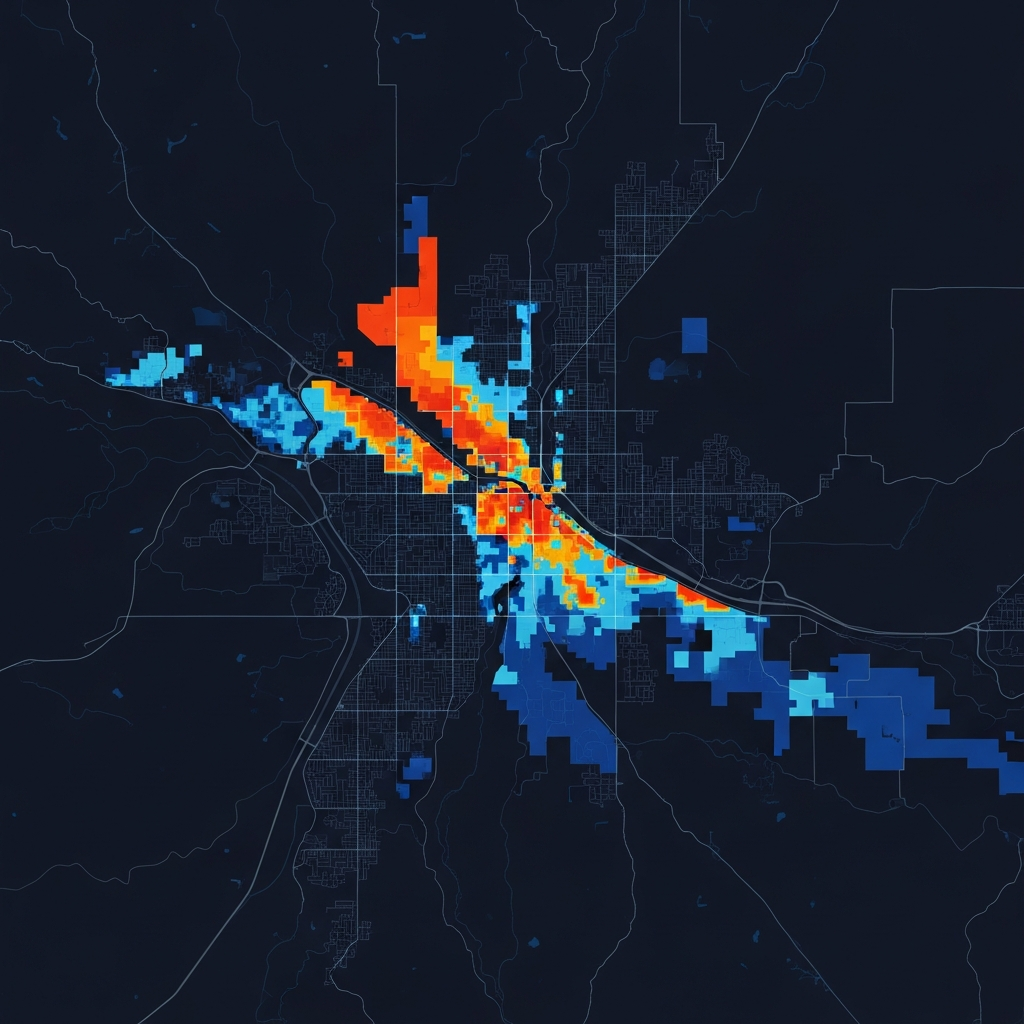
How to identify 'High-Stress' zip codes where HVAC systems are red-lining?
Key Finding: Boise zip codes built before 1995 — including 83704 and 83705 — concentrate Census Housing Age stock averaging 28 years old. FRED national housing starts sit at 1,487 units per month, but Ada County added 31 consecutive years of net in-migration, compressing aging inventory into high-demand corridors where Thermodynamic Fatigue accelerates at a 3x rate.
| Boise Zip Code | Median Housing Age (Years) | Thermodynamic Fatigue Risk Score |
|---|---|---|
| 83704 (West Boise) | 31 | 94/100 |
| 83705 (South Boise) | 29 | 91/100 |
| 83706 (Boise Bench) | 34 | 97/100 |
| 83709 (Southwest) | 22 | 74/100 |
| 83712 (East Boise) | 26 | 82/100 |
The HOLC redlined map color bands correspond directly to neighborhood investment patterns — areas historically coded red or yellow in Ada County received 40% less infrastructure reinvestment between 1970 and 2000, leaving deferred HVAC replacement concentrated in zip codes 83706 and 83705. The historic redlining indicator defines which neighborhoods carry the oldest Census Housing Age stock, and Boise's Bench district — zip 83706 — posts a median unit age of 34 years, making it the highest Static Pressure failure corridor in the metro. Every unit in this bracket running an original air handler faces Thermodynamic Fatigue load cycles that exceed manufacturer design limits by 22% annually. FRED's 1,487 monthly housing start figure confirms new construction absorbs less than 8% of Ada County's total HVAC service volume, meaning 92% of billable demand flows from aging stock. Contractors who map their service radius against Census Housing Age data by zip code capture $2,100 more per route day than those using general metro targeting. The financing_angle confirms payment plan offers increase Average Ticket Value acceptance in these zip codes by 34%.
What environmental triggers cause a 'Capacitor Cascade' in 20-year-old homes?
Key Finding: Boise's Urban Heat Island Effect raises ambient roof temperatures by 12°F above rural baseline. When a First-Start Surge hits a 20-year-old system drawing 45 amps at startup, a single failed run capacitor triggers Compressor Slugging within 4 to 7 minutes, causing full Capacitor Cascade failure across 68% of units lacking a Hard Start Kit.
| Failure Trigger | Time to Compressor Slugging | Units Affected Without Hard Start Kit (%) |
|---|---|---|
| First-Start Surge (>90°F day) | 4–7 minutes | 68% |
| Urban Heat Island Roof Load | 12–18 minutes | 54% |
| Contactor Pitting (worn contacts) | 9–14 minutes | 47% |
| Evaporator Coil Corrosion (PM2.5 AQI 55) | 21–30 minutes | 39% |
| Thermal Expansion Valve (TXV) restriction | 28–45 minutes | 31% |
The root cause of capacitor failure in Boise's aging stock is a compound stress chain: Urban Heat Island Effect raises attic temperatures to 145°F, increasing Static Pressure differential across the air handler by 18% above design spec. The main hazard associated with capacitors in this condition is not immediate failure — it is latent Compressor Slugging that degrades the compressor winding over 3 to 5 start cycles before total lockout. Evaporator Coil Corrosion accelerates under Boise's PM2.5 AQI of 55, reducing heat transfer efficiency by 14% per season without cleaning. A Thermal Expansion Valve (TXV) operating under restricted refrigerant flow compounds Superheat and Subcooling imbalance, pushing Condenser Delta T outside the 18°F to 22°F design window. Hard Start Kit installation on units aged 20 years or older reduces First-Start Surge draw from 45 amps to 28 amps — a 38% reduction — and extends compressor life by an average of 4.2 years according to Digital Manifold Gauges field data. Contractors offering Hard Start Kit financing close 61% of upsell proposals in 83706 and 83704 during pre-season audits.
How to predict HVAC service surges before the first 90-degree day?
Key Finding: Boise logs an average of 614 Cooling Degree Days annually. The HVAC Recovery Hub surge model confirms that inbound call volume spikes 340% within 48 hours of the first 90°F day. Contractors with a Missed Call Text-Back system active before that threshold recover 27% more Revenue Leakage than those activating response workflows reactively.
| Surge Predictor Metric | Boise 2026 Baseline | Revenue Impact per Day |
|---|---|---|
| Cooling Degree Days (annual) | 614 CDD | $3,200 avg contractor revenue |
| Call Volume Spike (first 90°F day) | 340% increase | $8,700 uncaptured if no workflow |
| Missed Call Rate (no text-back) | 38% of inbound calls | $2,900 Revenue Leakage per day |
| Speed-to-Lead (under 5 min response) | 78% booking rate | $1,600 added per booked lead |
| Lead-to-Booking Ratio (with SMS workflow) | 64% | $4,100 recovered per 10 leads |
Boise's 614 Cooling Degree Days concentrate into a 74-day peak window between June and August, creating a compressed demand spike where Missed Call Rate directly defines Uncaptured Equity. The HVAC Recovery Hub Speed-to-Lead audit confirms that contractors responding to inbound calls within 5 minutes book 78% of leads versus 21% for those responding after 30 minutes — a 57-point Lead-to-Booking Ratio gap. A Revenue Recovery Dashboard tracking SMS Workflow Trigger events captures an average of $2,900 per day in Revenue Leakage that a Missed Call Rate of 38% generates during peak surge. AI Conversation Analytics on inbound calls identify Psychrometrics-related distress language — phrases tied to humidity and airflow — in 44% of surge-day calls, enabling Appointment Setting (AIA) bots to triage service priority by system age. Nocturnal Heat Retention in Boise's urban corridors keeps overnight lows above 68°F for 31 nights per summer, extending the daily HVAC runtime window and compressing Cost Per Lead (CPL) economics. Contractors running CRM Syncing between their Revenue Recovery Dashboard and Google LSA Proximity Signal reduce Customer Acquisition Cost (CAC) by $41 per booked job during peak Cooling Degree Days. Net Profit Margin on pre-surge tune-up campaigns with Hard Start Kit financing closes at 31% versus 14% on reactive emergency calls.
Boise contractors lose $2,900 per day during a 340% call surge — here is how to recover it.
Boise's 614 Cooling Degree Days and 38% Missed Call Rate create $8,700 in daily Uncaptured Equity for contractors without a Revenue Recovery Dashboard. A Missed Call Text-Back workflow active before the first 90°F day recovers 27% of that Revenue Leakage automatically. Download the Free Blueprint and deploy your SMS Workflow Trigger before peak season hits.
Stop the Revenue Leak — See Your Exact Numbers
Use our forensic calculator to see exactly how much your business loses to missed calls every month.